The global recycling crisis isn’t a collection problem; it’s a sorting problem. For decades, municipal recycling centers have relied on manual labor and legacy mechanical sorters to separate a chaotic torrent of plastics, metals, paper, and glass. The result? High contamination rates, soaring operational costs, and millions of tons of recyclable material diverted straight to landfills.
Enter AI recycling automation. By combining computer vision, deep learning, and advanced robotics, modern material recovery facilities (MRFs) are undergoing a massive technological overhaul. Here is how artificial intelligence is transforming the way the world processes waste.
The Core Technology: How AI “Sees” Waste
Traditional automated sorters rely on basic physics—magnets for ferrous metals, eddy currents for aluminum, and near-infrared (NIR) sensors to detect broad plastic categories. While effective for simple streams, these systems fail when materials are crushed, dirty, or layered on top of one another.
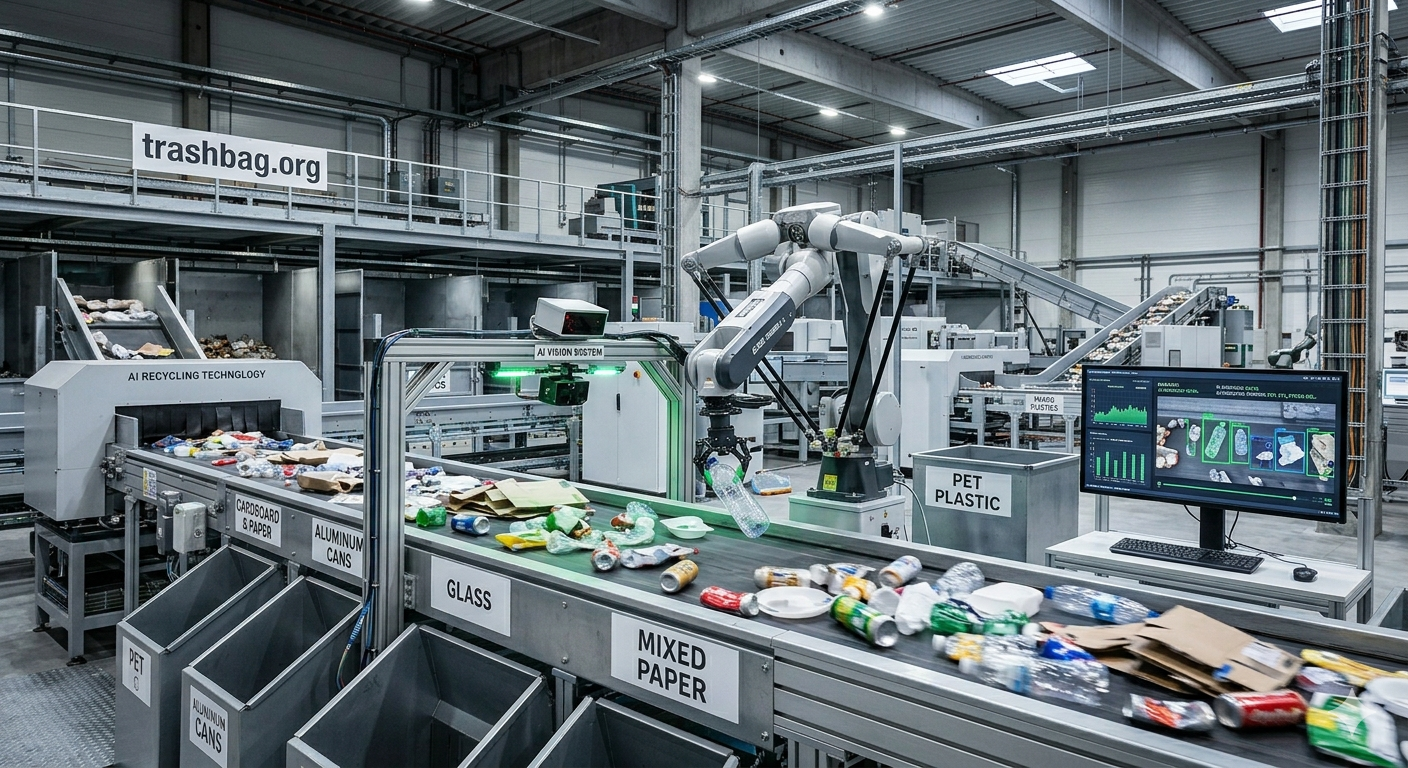
AI sorting systems use computer vision coupled with deep learning models trained on millions of images of waste.
-
Object Recognition: The AI doesn’t just look at the material composition; it recognizes the item’s form factor. It can differentiate between a high-density polyethylene (HDPE) milk jug and a crushed PET water bottle instantly.
-
Contamination Detection: AI can detect food residue, chemical hazards, or non-recyclable materials that would otherwise ruin an entire batch of processed plastic.
-
Real-Time Learning: As new packaging designs enter the global consumer market, neural networks update across entire fleets of sorting robots simultaneously, ensuring the facility adapts without needing hardware upgrades.
From Sight to Action: Robotic Interventions
Once the computer vision system identifies an object on a high-speed conveyor belt (often moving at over 2 meters per second), it triggers mechanical action. Depending on the facility’s infrastructure, this happens via two main methods:
1. Optical Air Jets
For lightweight materials like paper, cardboard, and flexible films, the AI coordinates with precision air nozzles. A targeted blast of compressed air shoots the specific item upward into a designated chute, leaving the remaining waste undisturbed.
2. Delta Sorting Robots
For rigid plastics, electronics, and metals, spider-like Delta robots equipped with vacuum suction cups or mechanical grippers physically pluck items off the line.
Performance Metric: While a human sorter can accurately pick roughly 30 to 40 items per minute, an AI-driven robotic arm can sustain 80 to 120 highly accurate picks per minute indefinitely, operating 24/7 without fatigue.
Global Impact: Data-Driven Waste Infrastructure
Beyond physical sorting, the most significant advantage of AI integration is data generation. Every single item passing under an AI camera is logged, classified, and analyzed. This creates a wealth of real-time data that allows facility managers to:
-
Optimize Plant Efficiency: Track composition changes in incoming waste streams depending on the season or neighborhood demographics.
-
Enforce Supplier Accountability: Identify exactly which commercial suppliers or municipalities are delivering highly contaminated loads.
-
Predict Market Value: Gauge the volume of high-value materials (like clean aluminum or clear PET) currently being processed to optimize sale timing to secondary manufacturers.
The Road Ahead
Implementing AI recycling automation requires significant upfront capital investment, which has slower adoption rates in developing regions. However, as sensor costs drop and edge computing becomes more powerful, localized modular AI sorting units are beginning to emerge globally.
By removing human error and handling hazardous waste separation autonomously, AI is bridging the gap between theoretical sustainability and economic viability.